Trans Love, Noir, and “Zaire”
About two-thirds of the way into our conversation, Iman DuPree tells me — almost in passing, the way you mention weather — that while filming the ending of their debut feature, the crew walked into the National Guard. Georgetown. Automatic rifles. The Potomac at their backs. They were there to shoot the last scene of a love story, and the city around them had been turned into a set nobody on that crew had designed.
DuPree explains this is what noir is.
Iman means it structurally, not aesthetically. DuPree is precise about this. What most people love about film noir, they argued, are the tropes. The shadows, venetian blinds, and the cigarettes. But what they love is the condition: noir was made on the heels of calamity. DuPree was filming a Black trans woman in love, in black and white, in a militarized capital, during a moment that will be in the history books.
They did not have to reach for the genre; the genre came to them.
Zaire has since traveled, going from festival to festival, Sweden to Athens, receiving honors for a film made with scraped-together grants and self-funding by someone who never got the industry's permission and stopped waiting for it. Iman’s advice to the next generation of Black and brown trans and queer filmmakers is not gentle, and it is not complicated:
Hollywood is not real. We are.
Marie-Adélina de la Ferrière: For POLISHed Ones not following you (yet!), tell us a bit about yourself.
Iman DuPree: I'm a D.C. transplant from Chesapeake, Virginia. I've lived mostly on the East Coast all my life, and when I got here in 2010, I fell in love with the city. Since then I've made a pivot out of the tech world and into filmmaking. Narratively, I found my footing in cinema, so I started this journey of wanting to create independent pictures.
I actually got into film school at MICA, and I had to choose: could I afford film school, or could I afford to make my debut picture? I chose the latter, and I'm really, really thankful that I did. Now that I've made that step, I know this is the space I want to keep creating in, focused specifically on intersectional storytelling. Showing folks on screen who have historically been omitted, and creating narratives that, unfortunately, have too often been created by other people for us. I'm excited to keep building here in the States and internationally. That's the path I've forged for myself.
The film began its life as Love Me in the Light. A title change is rarely just a title change; it's a thesis shift, sometimes a reckoning. What did you learn between those two names, and why does Zaire's name, standing alone, carry the story now?
Love Me in the Light was always the thing I wanted people to walk away with. If it wasn't a film you liked, if you didn't understand some of what happens in it as it relates to Black trans women, that was simply the message I wanted to leave you with.
But as we were filming, a number of things changed. We shot the ending first, out in Georgetown, during a military occupation. It was a perilous journey. And while we were out there, we had this magical moment on the Potomac. When you see the film, you'll feel what that moment is.
I named the character Zaire strategically, because I know the trans experience is a global challenge. I wanted this to reach across the diaspora and not stay inside the context of the States. The name comes from the Democratic Republic of the Congo [formerly known as Zaire], and it means a river that swallows all rivers. The way the film ends is what made me say: I think this is what encapsulates the spirit of evolving. Of growing beyond a space we've been kept in, toward where we can actually be. That's what moved me from Love Me in the Light to simply naming her.
You wrote two rules into the bones of this film: Zaire would not face physical violence, and she would not do the work for Marcus. In a moment when trans narratives are still shaped by what's done to us rather than what we choose, talk about the discipline of refusing those defaults, what it cost, and what it freed.
So many Western narratives focus on the hero's journey, and as an artist I wanted to pivot from that by default. And then, when you look at what's put out there in media about trans people, it is always centering violence.
Having those rules for myself pushed me to go deeper. To your point about what happens to us rather than what we choose — so much rests in Zaire's choices. What does she do when these things happen? What's her interior? What does that look like for her?
I chose a narrative structure called kishōtenketsu, a four-act structure from Asian storytelling that does not require conflict to drive the story. Embracing that let me think more carefully about what she endures, but also how she evolves inside her choices: the complexity and the nuance in what she decides. It was a creative challenge, of course. It was my first screenplay. But wanting to pivot away from the Western approach is what pushed me in that direction.
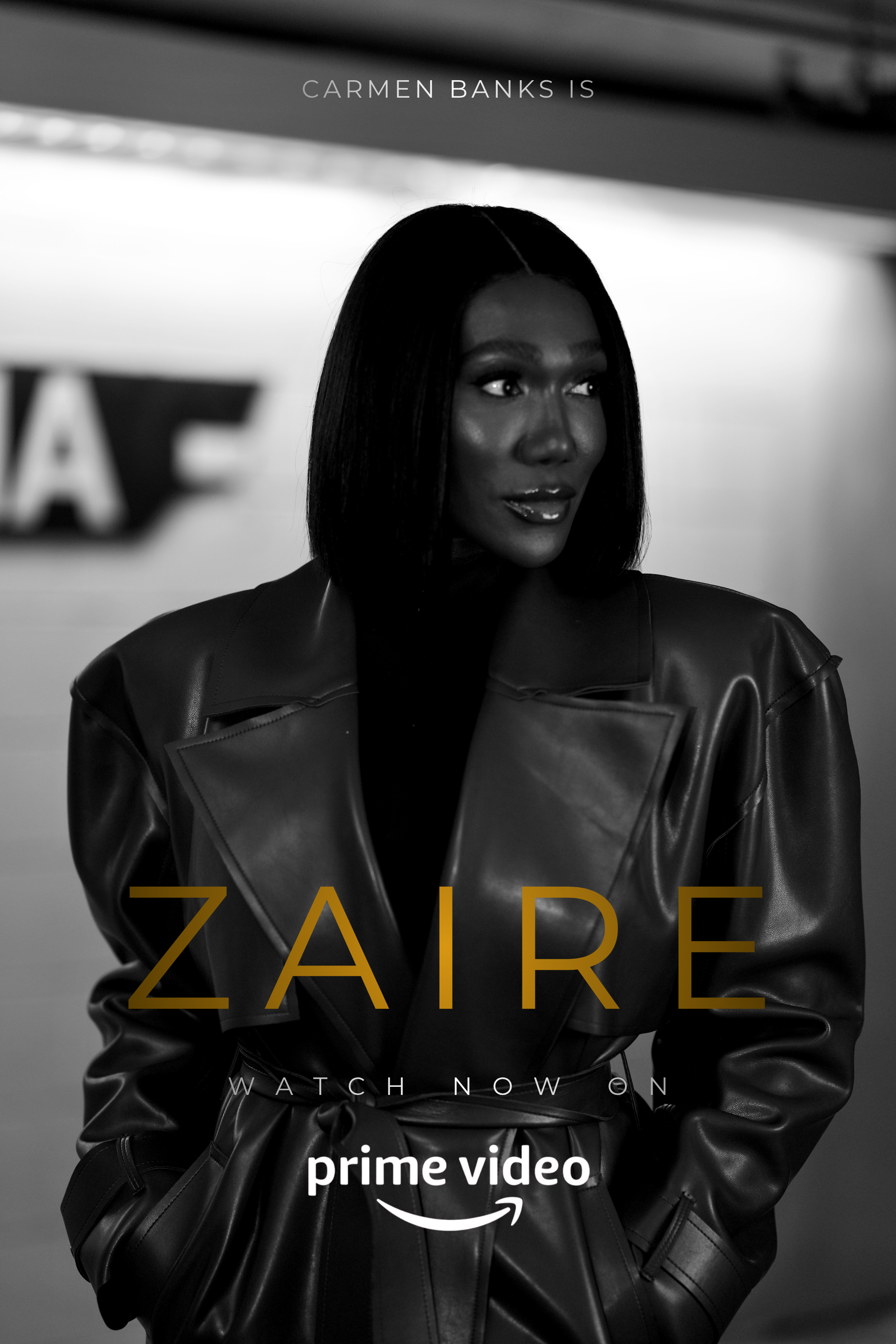
Carmen Banks as the title character. (Promotional flyer; courtesy of Iman DuPree)
You draw a through line from Frances Thompson, a Maryland-raised Black trans woman who testified before Congress after the Memphis massacre in 1866, to Zaire in 2026. A hundred and fifty years, and the life expectancy hasn't moved. How does carrying that lineage shape the way you direct a scene, frame a shot, or hold a silence?
Looking at how very little has changed in 150 years shapes the choices, and it ties directly back to your last question.
One of the ways it shows up is pacing; I really appreciate organic pacing. There are many moments where you watch Zaire think. And considering that life expectancy, you see how in certain situations there's danger, there's risk, and she takes the time to feel things out.
As Carmen [Banks] and I were working through this, we talked extensively about what scenes would embody, what the feeling is, how to explore different parts of Zaire's interior. It made me approach the whole thing with a great deal of empathy. And being out in the city filming this, having to move as quickly as we could, I tried to stay as present as possible and remember why we wanted to create it. It inspired me to be cautious, to be gentle, to take care. With the hope that other people of trans experience feel what this is.
The pairing at the center — a Black trans woman and a Black bisexual cis man — is a configuration you've said you'd never seen on screen. Black bisexual men carry their own erasure inside Black cinema. What conversations did you have with your team, and with your actor, about the tenderness this role required?
Marlon Riggs wrote an essay some time back about how Black cinema had continued to grow — more filmmakers than at any other point in history — and yet Black bisexuality, as it relates to cis men, still wasn't present.
I didn't want the character to focus solely on sexuality. I wanted to bring that identity forward inside a conversation where Zaire and Marcus reveal things to each other. Zaire is so smart. She sees right through a lot of things, and the way it surfaces between them is jarring, piercing and she stands strong in it. It's a small facet of her identity, but it's a necessary complexity for what we're exploring.
I made Marcus bisexual because I did not want to do the DL narrative thing. I did not want to go that route. We've seen that before, in cinema and in television. I wanted more complexity: even though he's bisexual, what does this love dynamic — or the prospect of love in this dynamic — actually look like for him?
And Benji is just so wonderful. Here's the thing: I originally didn't offer Benji the role of Marcus. I talked to him about something else, and he said, "No, no, no. I want the lead." I said, are you sure? Let's talk this through. So we had an entirely different conversation, and bisexuality was very much part of it, because I think so many Black men need to see that this is shared among many of them. This is not new by any stretch of the imagination, and there's no shame to be had in it. We tried, as delicately as possible, to make it a conversational piece of his identity and not just the sexual piece.
Let's go back to the occupation. You filmed during a military occupation of D.C., and the film itself unfolds against the backdrop of the COVID-19 lockdown. Two quarantines. Two kinds of enclosure: one now historical, one happening as the cameras rolled. How did that double context press into the performances and the visual language?
I love that question, and I'll tell you why. To frame it: I love film noir. I love film noir. Elevator to the Gallows. But what most people focus on with noir are the tropes of noir. They don't focus on the structures those films were built on. They were created on the heels of calamity. After wars. After the Great Depression. After societal, sometimes global, impacts that shaped who people were allowed to be, and let them dream of new possibilities.
So when you frame us filming inside a historical moment, while also being present in it, that's what neo-noir is. That's the black-and-white imagery. At one point we literally bumped into the National Guard. They were out there with automatic rifles. It was jarring. But this is literally what noir is.
In the film's visual language, it's the black and white, but it's also the pacing, and the center framing of the characters, so you feel their world and how they fit inside it. It's mostly shot indoors, so by the time you get outside, I want you to feel that emptiness. For the first exterior, I shift into video stills instead of moving images. That was inspired by Eraserhead, the way that opening gives you a dystopian space that's empty and desolate. And then you meet Zaire outside for the first time, and she is this joyous, happy, excited human being, looking forward to a moment she's about to share with someone. I'm so proud of it.
Your practice braids portraiture, poetry, and filmmaking. Where does the poet in you end and the director begin on the set of Zaire?
I don't think there is a beginning or an ending to it. The poetry shows up in my style and in my approach to connecting with Zaire, with Marcus, with Troy [played by Aaron Davis].
There is such a language in human connection, and illustrating human behavior takes taste and an understanding of humanity. When you understand how vital poetry is to our survival as human beings, to our joy as human beings, it becomes a double-edged sword that doesn't seem to end.
Poetry saved my life…Whether it was what I had going on in the moment, or embracing being trans and non-binary, or understanding the pitfalls in love — so many facets of poetry showed up and affirmed me. So I put poetry inside this tale out of love for it, and also to show other people: this is a way we can survive and evolve. By reading. By embracing poetry. By seeing that so many other people have lived these experiences.
The film has moved through its festival run, with honors from Sweden to Kolkata to Athens. What do you want the next generation of Black, queer, and trans filmmakers to take from how you built this? The self-funding, the grants, the refusal to wait for permission?
I want people to understand that Hollywood is not real.
What we do as artists — as trans people, as people of trans experience — is create ourselves in our own image. And the work we're capable of, if we connect with one another to make it, is unstoppable. We're endless. In the messages we create, in the stories we can tell.
I sat on this story for a while, because trying to secure funding was a challenge. But when I finally engaged Carmen about what it could look like, it went from a request for fifteen minutes of her time to a four-hour conversation. Being on the other side of having made it, I'm so excited to create more with more intersectional people.
It is 100% possible to make our own narratives. We might have to scratch and crawl and scrape for funding from every corner of the earth, but when you see what's on the other side…wow. I want this to be the way we keep evolving each other. We look to each other. We don't have to look to an industry that is pushing us out more than anything.