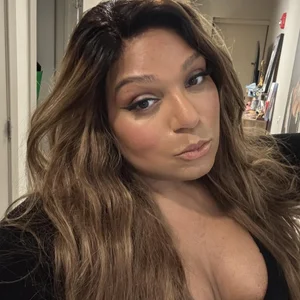
Sapphira Cristál brings her 'Expansive' voice to San Francisco
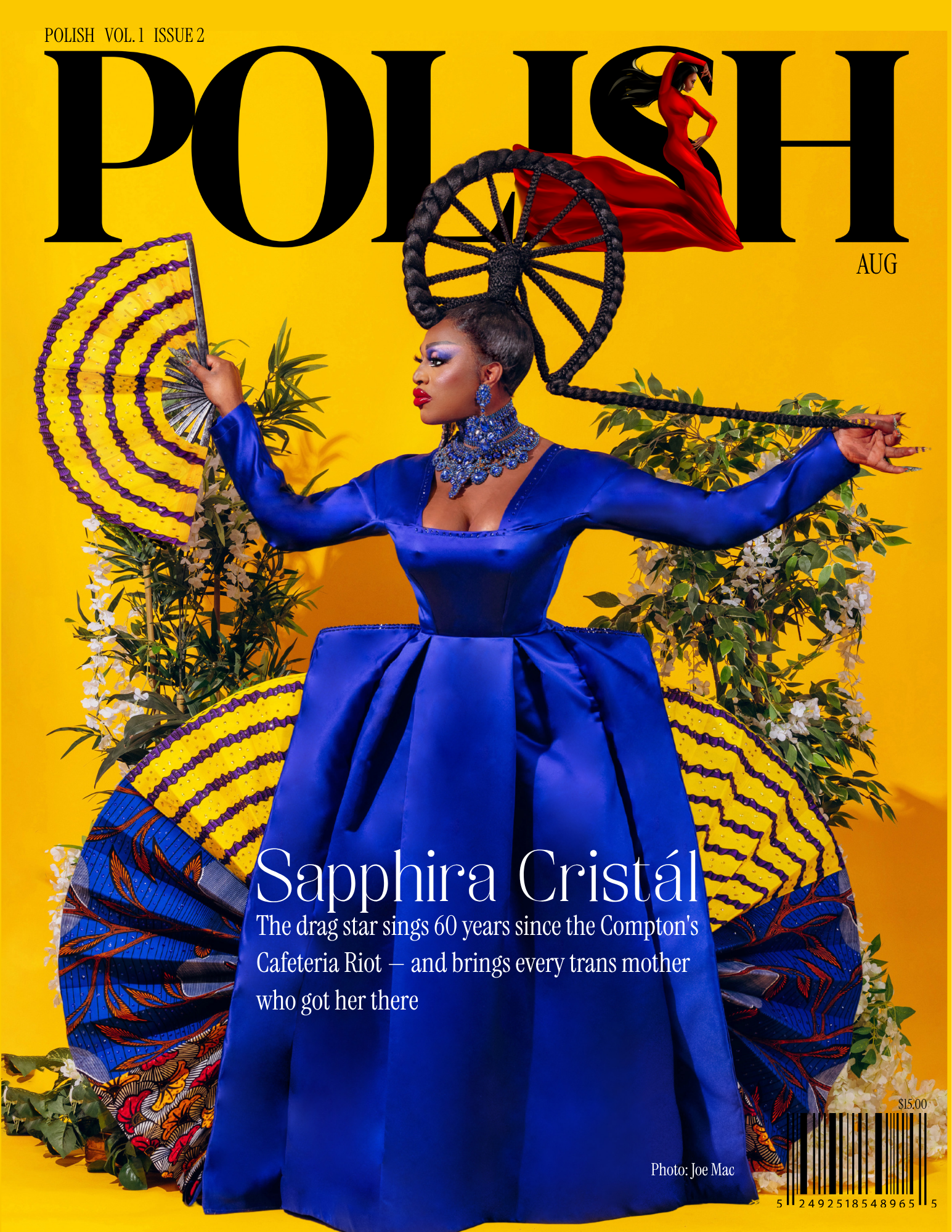
Drag star Sapphira Cristál. (Photo: Joe Mac)
Ask Sapphira Cristál where she's from, and you may want to sit down. Philadelphia. Provincetown. Boston. New York. Houston. But the answer she offers with the most ceremony in our conversation is this one: Rochester, New York.
She started at the Eastman School of Music to study composition and vocal performance. But the thing that turned a composition major into a performer wasn't a conservatory. It was a night at Tilt, one of Rochester's late gay nightclubs, watching a Black trans queen named Miss Deelicious work the room. Deelicious became the first of several drag mothers who nurtured Sapphira into the star she was destined to be. Cristál went on the sixteenth season of RuPaul's Drag Race and came out of it runner-up and Miss Congeniality. And, as they say, the rest is history.
Today, she makes her debut at Expansive, the annual showcase of transgender and non-binary singing artists co-presented by Opera Parallèle and The Transgender District. Now in its fifth iteration, this year's program pays tribute to the 60th anniversary of the Compton's Cafeteria Riot, the 1966 uprising of trans women and drag queens in the Tenderloin, predating Stonewall by three years.
Our conversation moved between opera as drag and drag as opera, big voices in small rooms, and the Black divas of classical music. Somewhere in the middle of it, she made me do a breathing exercise on the record and then told me, plainly, that she didn't believe me the first time.
She was right. So I did it again.
Marie-Adélina de la Ferrière: You mentioned you’re a classically trained performer. A bass-baritone, I believe?
Sapphira Cristál: I was trained as a bass-baritone and as a soprano.
And then you ended up going into pageants and drag. What pulled you into realizing that these two very separate paths are actually one?
You know, one day you look in the mirror, and you see how pretty you are. And for some people, they see how pretty they are, and they realize the life I’ve been living is not the life that I want for myself anymore, or that feels right for myself. It’s not the path I should be on any longer. And then they make certain other choices. And for me, I live in the in-between. So I can appreciate and love all parts of myself.
And I was like, I am an entertainer, first of all. I was going to Eastman as a composition major, which meant I was going to be behind the scenes most of the time. Lots of people compose their own music and then go perform it. But I was writing a lot for sopranos. I was writing for contraltos. Not as much for men, or baritones and basses. And I don’t play any string instruments, and I was writing lots of things for those as well.
So at some point in my life I was like, you gotta do what you know you wanna do. And I’m supposed to be on stage. I’m supposed to be on screen. I’m supposed to be in front and not in the back.
I would always dress up as my favorite opera singers, like Leontyne Price and Jessye Norman. I would do that and feel...so cunt. I think I did drag my senior year of high school as Leontyne Price; everyone thought I was Whitney Houston. Then I did drag as Leontyne Price my freshman year at Eastman, and everyone knew it was Leontyne Price, thank God. I’m in Mu Phi Epsilon, and we have to do recitals. For one of my recitals, I dressed up as Jessye Norman. I used a big blanket as my muumuu, and we sang “Scandalize My Name,” my friend Jarrett and I. And I realized this is the kind of entertainment I love.
But what really took me there is I went to Tilt, and Deelicious was performing. There was a girl named Jenna who was at Eastman as well, and she was Mu Phi Epsilon, so she was my frat brother...frat sister, whatever you want to call it. She was performing, so we went to go see her. And then after Jenna, Deelicious came out. I remember seeing her come out — she did “Diva” by Beyoncé — and the way the audience was just worshiping her, the energy that permeated off this woman. I was like, I gotta do that. I gotta do drag. This is what I’m meant to do. This right here is what I’m meant to do.
It’s a small club, but to me it looked larger than life. And it’s taken me very, very far; I tell you that. There’s singers everywhere, and they’re all doing their own thing, and they all want a piece of this little bitty pie. So to be able to separate myself from that huge group of people in a way that says, okay, well, I’m me, and I’m doing this.
You’ve performed everywhere from large concert halls to small drag venues. How do you adjust your performance vocally and physically for rooms of different sizes?
Well, I have a very large voice. So depending on what I’m doing, especially if we’re talking about just vocal performances, if I’m in a room that doesn’t really have great acoustics, then I have to use a mic. It’s not something I like to do, but it’s something that makes the most sense so that everyone can get the same experience.
I’ve recently been to opera houses where the person just didn’t have a big enough voice and I could barely hear them. And I was kind of close...There are big voices still out there, but the smaller voices get more attention, because smaller voices develop faster. They can get out there quicker; they can perform a lot more; they can do a lot of things. But it’s a small voice. Me, I’m a big fan of the big voice.
So here in Provincetown, I can’t sing on these mics, because the room is small and the sound system isn’t really equipped for my size of voice. So when it comes to certain things, I’m like, okay, all right, I’m gonna sing; turn off the mic. And I sing it in a room while they’re playing the music on their system, but I reach every part of the room with just my voice. And then when I was in Cincinnati, we did it outside. You have to use a mic for that, because if you don’t, then your voice just gets lost in the world.
What’s the last piece of music, opera or otherwise, that genuinely surprised you or changed how you think about your own voice?
I have been writing Christmas songs with a friend of mine, and as we were writing, I started to realize that I love singing with a big band. Part of my big voice is that it pairs well with a big sound. And there’s not a lot of people who can sing with a big band, because you have to really be able to ride that wave of this huge sound, and sometimes it can overwhelm the singer.
I realized that some of the reasons why people don’t sound good doing what they’re doing is because they’re not paired correctly. Someone’s paired with too small of a room, or too small of a band, or too big of a band. And I realized I really like singing with big band, because the instrument would be so perfectly paired with that. I think I really want to do this more often, which got me into singing more things from the '40s and '50s and '60s; the Rat Pack era; in the style of Sarah Vaughan and Ella Fitzgerald, but also with my bass-baritone flair. It’s been quite interesting, kind of falling into this place where it’s like, you can still use all of this training that you have, but take it into the genre of jazz.
You’ll be performing at Expansive as part of the Transgender District’s weekend of celebrations, and this is your first time doing it. What made you say yes to this particular show at this particular moment?
Well, they asked me. I am a person who always says yes. If it makes sense, I try to say yes as much as possible. I say yes until it doesn’t make sense, actually. I believe in the adage to just say yes to life. And they asked me to sing opera. It’s got my favorite things: trans experience and trans life, trans people and trans love, and opera. There’s no reason for me to say no. There’s every reason for me to say yes.
I’m very excited about it, because it’s not something that I knew about. I read about it, watched some of the older shows, and was like, well, why haven’t they called me before? But I’m happy that they did it this time. I felt very ready, especially when they asked me. I’ve just been in residence in Provincetown for the last six weeks, so my voice is a little tired. But it’s gonna be really fun. It’s gonna be a fun time.
What do you want the people who’ve been with you through many auditions and many shows to walk away with after your performance at Expansive?
All you gotta do is dream. And then get up and live the dream. Because that’s what I feel like every trans person does, right? They live their dream. They live their life. They live the experience that they need to have. And that’s something that I’ve learned. My mother in Rochester is trans. My mother in Boston is trans. My mother in Philadelphia is trans. All of my mothers, all of the people around me are trans. My partner is trans. I’m non-binary, but I’ve been raised in this love of trans people, and in this love and admiration of people who have the nerve and the courage to stand in their truth and stand in who they are, knowing where we are. I chose specific music to sort of tell this story. So I hope that at the end, people feel supported, emboldened, and strengthened. And people feel like, all I gotta do is what I wanna do as long as it don’t hurt nobody. And then I can help somebody else when I live in my truth, when I truly love and accept who I am.
I always do a little exercise in all my shows, and pretty much all my interviews too. Would you do it with me? You put your hands up in the air, and you wave them. I call this the release and the charge. And then you wrap your arms around yourself, you breathe in deep, and you say: I truly love and accept myself.
I truly love and accept myself.
But you have to do it like you really mean it…I didn’t believe it. Let’s try it one more time. Breathe in deep. I truly love and accept myself.
I truly love and accept myself.
Yeah. And doesn’t that feel good? It feels good to be able to just be there for yourself. I always tell people to truly love and accept who they are, where they are, and how they are. You’re perfect every day of your life. And the person you were yesterday got you exactly where you are today. And the person you are today will take you to your dreams in the future. But you must nurture that person and let them know they are worthy of love. And I hope that at the end of our experience together — well, anywhere I go — people get that message.
Usually, that's where most of my interviews end. But what Sapphira didn't know is that her first drag mother is not just someone I know in the community: she's a dear friend. So I asked if she wanted me to call her; Sapphira said yes, and so we did. Two people on a work call, patching in a Black trans figure and local legend, and, true to a mother-daughter relationship, picked up like they just saw each other the other day.